Kos Minar1.0edi.wi886ნაშC
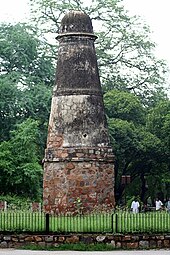

The Kos Minars (Persian: کوس مینار) (Translated: Mile Pillars) are medieval Indian milestones along the Grand Trunk Road in northern Indian subcontinent, that were made by the 16th-century Pashtun ruler Sher Shah Suri. Kos Minars were erected to serve as markers of distance along royal routes from Agra to Ajmer, Agra to Lahore, and from Agra to Mandu in the south.
Kos Minars were described as a "marvel of India" by early European travellers such as Sir Thomas Roe and have been labeled as an integral part of India's ''national communication system" by Archaeological Survey of India.[1]
Contents
- 1 History
- 1.1 Mughal period
- 2 Characteristics
- 3 Preservation
- 4 Gallery
- 5 See also
- 6 References
History[edit]
A kos is one fourth of a yojana,[2] an ancient Indian unit of distance. It represented a distance of approximately 3.22 kilometres (2.00 mi). Minar is a Persian word for tower.
In the third century BC, emperor Ashoka initiated routes linking his capital city Pataliputra to Dhaka in the east and Kabul via Peshawar in the west and further to Balkh. These routes had landmarks in the form of mud pillars, trees or even wells to guide commuters.[3]
Abul Fazl recorded in Akbar Nama that in the year 1575 AD, Akbar issued an order that, at every kos on the way from Agra to Ajmer, a pillar or a minar should be erected for the comfort of the travelers.[4][5] Englishmen brought back detailed reports of the Kos Minars between 1615 and 1618.[3] In 1619, Emperor Jahangir ordered Bakir Khan, Fauzdar of Multan to erect a minaret at every kos.[6] In addition, many caravanserais (roadside inns) were built for travelers.
Mughal period[edit]
Kos Minars became an institution during the rule of the Mughals. Emperor Jahangir and Shah Jahan, following in their predecessors' footsteps, added to the network of Kos Minars. In the Mughal period, there were around 600 minars.[1] In the north, they were extended as far as Peshawar and in the east to Bengal via Kannauj. The geographic span of nearly three thousand kilometers would call for nearly 1000 minars.
Characteristics[edit]
Kos Minars are solid round pillars, around 30 feet (9.1 m) in height, on a masonry platform built with bricks and plastered over with lime. They were not identical. As milestones, they were an important part of communication and travel in a large empire.
Preservation[edit]
Over the years, these road monuments have gone into a state of disrepair, as local residents do not know their significance.[3] Only 110 are left.[1] Along with India's old highways, particularly the Grand Trunk Road, one still finds Kos Minars.
According to a report of the Archaeology Survey of India, there are 49 Kos Minars in Haryana.[6][7] There are also five Kos Minars around Ludhiana city.[8]
The Archaeological Survey of India have given Kos Minars protected status and courts have ordered encroachments cleared away. Restoration work for nine Kos Minars near Mathura began in 2018.[3]
Gallery[edit]

Kos Minar along Grand Trunk Road at Taraori in Karnal district of Haryana.
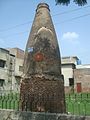
Kos Minar built with lakhori bricks near the Tomb of Ali Mardan Khan in Lahore, Pakistan.

Kos minar at Palwal along Grand Trunk Road in Haryana.

Kos minar near Karnal along Grand Trunk Road in Haryana.

Jahangir era Kos Minar at Dakhini village in Jalandhar along Grand Trunk Road.

Kos Minar# 793 at 12 mile on Agra-Fatehpur Sikri Road section of National Highway 21.


See also[edit]
- List of Monuments of National Importance in Haryana contains over a dozen Kos Minars in Ambala, Faridabad district, Palwal, Rohtak district, Sonepat district, Panipat district, Karnal district and Kurukshetra district
References[edit]
 |
Wikimedia Commons has media related to Kos Minar. |
- ^ a b c "Sher Shah Suri's kos minars once meant to show way to travellers stand lost today - Times of India". The Times of India. Retrieved 21 December 2018.
- ^ Arthashastra, Chanakya, 4th century BCE, pp151
- ^ a b c d Arvind Chauhan (2 March 2019). "These were the 'Google Maps' of 16th century, now they're lost in time". The Times of India.
- ^ Kos Minar University of Alberta.
- ^ Khandekar, Nivedita (27 October 2012). "A milestone on the highway". Hindustan Times. Archived from the original on 23 September 2013. Retrieved 20 March 2018.
- ^ a b "Kos Minar". Haryana Tourism Corporation. Retrieved 2 March 2019.
- ^ "Signposts lost in history". The Sunday Tribune. 10 September 2006. Retrieved 23 September 2013.
- ^ "'Monumental' treasure house". The Times of India. 12 July 2009. Retrieved 23 September 2013.